
 Fundraising Commons Team 4 min read
 The board-meeting number: campaign reporting that survives scrutiny
About the Author
The open, vendor-neutral commons behind the Advancement Common Data Model (ACDM™) and its free educational resources. We write about trustworthy advancement data, portability, and AI-readiness for fundraising teams of any size. Stewards are credited in the colophon, never in the byline.
The board-meeting number is the single figure you stand up and present: “the campaign has raised $X.” Whether it survives the room depends entirely on work you did before the meeting: deciding what counts as raised, which date governs, whether pledges are in, and who owns the figure. Campaign reporting that survives scrutiny is reporting whose definition was settled in advance, not defended on the spot.
How do you report campaign results to a board?
You present one number, and you’re ready for the questions behind it. The number itself is the easy part; what earns trust is being able to answer, without hedging, how it was calculated, because a good board will ask, and “let me get back to you” is how a campaign loses credibility in a single meeting.
The questions a good board will ask
Five, predictably:
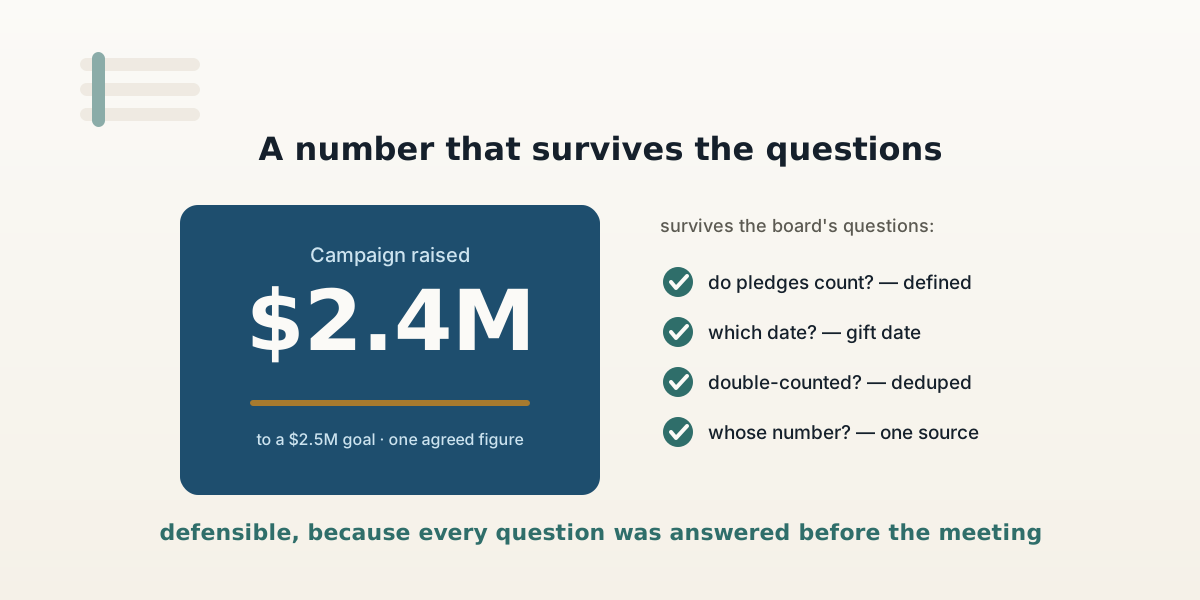
- Do pledges count, or only cash received? A $2.4M figure means different things depending on the answer, and both are legitimate if stated.
- Which date governs? Gifts attributed by gift date vs. entry date can move money across the reporting period (gift date vs. entry date vs. batch date).
- Is anything double-counted? Duplicates and mis-handled soft credits inflate totals (soft credit vs. hard credit).
- Whose number is this? If two staff can produce two figures, neither is trusted (why your reports disagree).
- Against what goal? A number without its denominator isn’t a status.
A board number isn’t defended in the meeting. It’s decided before it, so that every question has an answer you settled weeks ago.
Decide the definition before the campaign
The fix is to write the campaign’s reporting definition at launch, when no number is at stake and the choices are easy to make on principle. Pin: what counts as raised (pledges, cash, in-kind), which date, how dedup and soft credits are handled, and who runs the official figure from which source. Then every monthly update and the final board number all compute the same way. This is the campaign-specific case of the discipline in the year-end data checklist. Settle it before the rush.
A worked example
A synthetic capital campaign reports $2.4M to a $2.5M goal (illustrative). What makes that number defensible isn’t the figure. It’s the one-line definition behind it:
Raised = signed commitments + cash received, attributed by gift date, deduplicated, soft credits excluded from the total, reported from the campaign module of record.
Now when a trustee asks “does that include pledges?”, the answer is “yes, signed commitments are counted; here’s cash-in-hand separately,” delivered in one breath. The number holds because the thinking happened in advance.
The pledges-vs-cash choice that trips up campaigns
The most common board dispute is commitments vs. cash. A campaign total that counts signed pledges shows momentum; a cash figure shows what’s actually arrived. Both matter. The error is reporting one while implying the other. Keep them as two clearly-labeled lines (committed vs. received), which is only possible if your data separates the commitment from the transaction in the first place.
The pre-meeting checklist
Before you present: confirm the definition is written and unchanged since launch, that pledges and cash are shown as separate lines, that the figure came from one agreed source, and that you can state the dedup and soft-credit handling in a sentence. Four checks, and the meeting stops being an interrogation.
What you get
A campaign number you present with a straight back, a board that trusts the reporting because the answers are instant and consistent, and an end to the quarterly ritual of two staff reconciling two “final” figures the night before. The number that survives scrutiny is the one whose definition you never have to invent live.
For the bigger picture of trustworthy reporting, see What Becomes Possible; to find your weak points, take the self-assessment.
Examples use synthetic data. The standard is open and early; treat current releases as drafts.
Related Articles
Before the year-end rush: the data checklist that protects your campaign numbers
Year-end giving is a stress test for your data. A short checklist covering gift dates, dedup, DAF and match attribution, and pinned definitions keeps your campaign number trustworthy.
Why the fundraising sector can't learn from itself, and what a commons would change
Nonprofits can't benchmark against each other because data is trapped twice over and comparing has meant exposing donors. A commons changes both. Here's the whole argument.
From hunch to score: prioritizing a gift officer's week with data
How do you prioritize a gift officer's portfolio? Replace gut feel with a transparent score built on clean, connected data, so the week's calls have a defensible order.