
 Fundraising Commons Team 4 min read
 Soft credit vs. hard credit: who actually gave?
About the Author
The open, vendor-neutral commons behind the Advancement Common Data Model (ACDM™) and its free educational resources. We write about trustworthy advancement data, portability, and AI-readiness for fundraising teams of any size. Stewards are credited in the colophon, never in the byline.
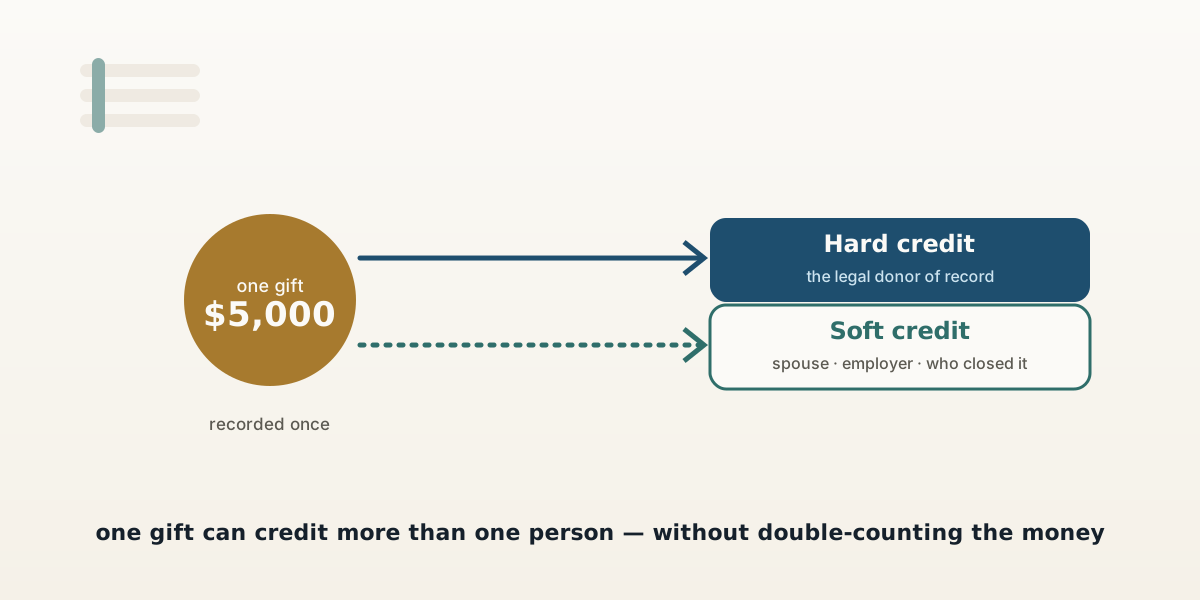
Hard credit is the legal donor of record, the party whose money it legally was. Soft credit recognizes someone else’s role in the same gift: a spouse, the person who closed it, a matching employer, the individual behind a donor-advised fund. The key idea that trips up most reports: one gift, recorded once, can credit more than one constituent, and if you don’t resolve that cleanly, “how much did this person give?” comes back wrong.
What is soft credit vs. hard credit?
- Hard credit answers a legal question: whose gift was it, for the receipt and the audit? There is exactly one hard-credit party per gift.
- Soft credit answers a relationship question: who else should be recognized for making this gift happen? There can be several, and none of them is the legal donor.
Both are attached to the same single gift. Soft credit does not create new money; it attributes existing money to additional people for stewardship and analysis.
Why one gift credits more than one person
The everyday cases where this shows up:
- Spouses / households. A check from one spouse is often soft-credited to the other so both see “their” giving.
- Matching gifts. An employer’s match is its own gift, frequently soft-credited back to the original donor who triggered it.
- Donor-advised funds. The legal donor is the fund sponsor; the individual who recommended the grant is usually soft-credited.
- The closer. Some shops soft-credit the gift officer or volunteer who secured the gift.
Soft credit attributes money; it doesn’t multiply it. The dollars are counted once. The recognition is counted as many times as it’s earned.
A worked example
A synthetic $5,000 gift at Pinemark Education Fund (figures illustrative). Dana writes the check; her spouse Sam is recognized; Dana’s employer matches separately:
| Party | Credit type | Counts toward revenue? | |---|---|---| | Dana (legal donor) | Hard credit, $5,000 | Yes (the gift) | | Sam (spouse) | Soft credit, $5,000 | No (recognition only) | | Employer match | Separate gift, hard credit $5,000 | Yes (its own gift) |
Dana’s gift is $5,000, counted once. Sam’s soft credit lets him see it in his giving summary without adding a dollar to the campaign. The employer match is a different gift, real new money, which is why it counts, and why it’s easy to accidentally double or miss depending on how it’s linked.
How double-counting happens
The classic error is computing revenue (or a donor’s lifetime giving) by summing credited constituents instead of summing gifts. Do that, and Dana’s $5,000 becomes $10,000 the moment Sam is soft-credited, and your “top donors” list fills with inflated, un-reconcilable totals. This is one of the quiet reasons reports disagree and donor counts come out three different ways.
The rule that prevents it
Revenue is the sum of gifts, never the sum of credits. Soft credits roll up to people for stewardship; they never roll up to totals. Decide, in writing, which figure each report uses and which credit types each metric honors.
How to handle it cleanly
Three habits keep credit from corrupting your numbers:
- Keep one money figure per gift. The hard credit is the dollars; everything else is attribution.
- Treat a match as its own gift. It’s new money with its own hard-credit party, linked to but distinct from the original.
- Resolve soft credits before person-level analysis. “This donor’s giving” is only right once you’ve decided which credits count. Where the gift object itself lives in the data, and how credit attaches to it, is part of the shared model; see the six objects every advancement CRM has.
Get this right and you can recognize everyone who deserves it and report a revenue number that reconciles to the penny, which is the whole point.
See where your data stands with the free self-assessment, or explore What Becomes Possible.
Examples use synthetic data. The standard is open and early; treat current releases as drafts.
Related Articles
What "lapsed donor" actually means, and why you must write it down
A lapsed donor gave before but not within an agreed recent window. But "lapsed" is a definition, not a flag. Pin the window, the gift types, and pledges. Here's how.
Why your reports disagree depending on who runs them
Two staff run the same report and get two numbers. The cause isn't bad data. It's undocumented definitions. Here's why fundraising reports drift, and the fix.
"How many donors do we have?" Why one question has three answers
Ask three people how many donors you have and you'll get three numbers. Here's why "active donor count" drifts, and the one habit that makes it agree.