
 Fundraising Commons Team 3 min read
 From hunch to score: prioritizing a gift officer's week with data
About the Author
The open, vendor-neutral commons behind the Advancement Common Data Model (ACDM™) and its free educational resources. We write about trustworthy advancement data, portability, and AI-readiness for fundraising teams of any size. Stewards are credited in the colophon, never in the byline.
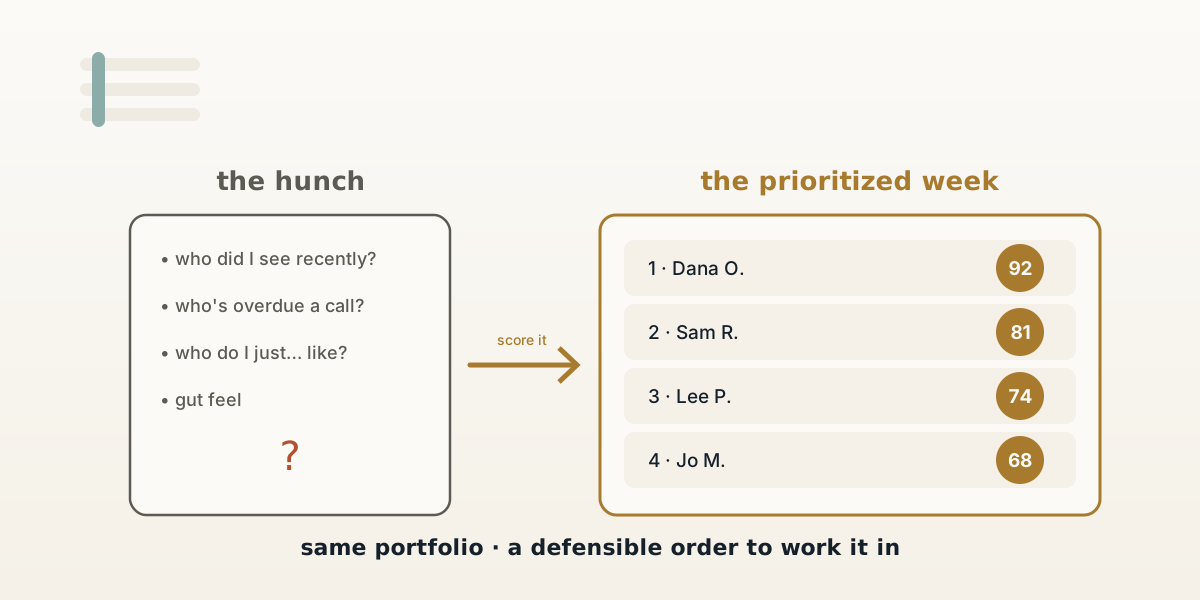
How do you prioritize a gift officer’s week? Most shops do it on instinct: who they saw recently, who feels overdue, who they simply like. A score replaces that hunch with a transparent, repeatable order built from data the officer already has. Not to overrule judgment, but to make sure the highest-potential conversations actually happen instead of getting lost under whoever emailed most recently.
How do you prioritize a gift officer’s portfolio?
You rank it. Instead of facing 150 names as an undifferentiated list, the officer gets a working order: who to reach this week, and why. The “why” matters as much as the order. A score nobody understands gets ignored, and should be. A good prioritization score is explainable: it points at the signals that earned the rank.
Why a hunch isn’t enough (and isn’t fair)
Gut feel is real expertise, but as a prioritization system it has three problems: it’s invisible (no one can check or improve it), it’s inconsistent (the same portfolio ranked differently on different days), and it quietly favors the recently-salient over the genuinely-high-potential. A donor who hasn’t emailed lately, but whose every signal says “ready,” falls through.
A score doesn’t replace a gift officer’s judgment. It makes sure the right conversations reach their judgment in the first place.
What goes into a score
A prioritization score combines signals the officer would weigh anyway, made explicit and consistent:
- Recency and cadence: when did meaningful contact last happen, versus when it should?
- Engagement: the interactions, not just the gifts (the constituent 360 view is exactly this raw material).
- Likelihood and ability: signals of propensity to give and capacity to give, kept distinct.
- Stage: where the relationship sits in your process.
A worked example
A synthetic officer’s Monday list. Before: 150 names, sorted alphabetically, worked top-down until time runs out. After: the same 150, ranked. Dana (92) surfaces because three engagement signals and an overdue cadence all point up at once; a donor the officer would have called from habit drops to 40 because nothing actually changed. Same portfolio, a defensible order, and the week’s limited hours spent where they’ll matter most.
The unglamorous prerequisite
Here’s the catch every vendor demo skips: a score is only as trustworthy as the data under it. Rank a portfolio where one donor is split across duplicate records, or where “last contact” reads the wrong date, and you’ve automated a worse decision, faster.
Don't score dirty data
A prioritization score computed on un-deduplicated, undefined data isn’t insight. It’s confident noise. The same foundations apply: one person is one record (how many donors do we have?), interactions are captured, and “last contact” uses the right date. Clean first, score second.
Keep the officer in the loop
A score is a starting point for judgment, not a verdict. The officer should be able to see why someone ranked where they did, disagree, and act on relationship knowledge no model has. The goal is a better-ordered week, not an autopilot. The human stays in charge of the relationship.
What you get
A gift officer’s limited hours pointed at the highest-potential conversations, a prioritization anyone can explain and improve, and an end to the quiet bias toward whoever happened to be top-of-mind. The hunch was never wrong to trust. It just needed the whole portfolio in view first.
For where this fits, see What Becomes Possible; to check the data underneath, take the self-assessment.
Examples use synthetic data. The standard is open and early; treat current releases as drafts.
Related Articles
Synthetic donor data: how to test cadences and policies safely
Synthetic donor data is artificial records that mirror your real data's patterns but describe no actual person, so you can test cadences, models, and policies without risk.
Propensity and capacity scores: what they are, and what they're not
Propensity is how likely someone is to give; capacity is how much they could give. They sit on different axes, and confusing them is the most common scoring mistake. Here's the difference.
Why the fundraising sector can't learn from itself, and what a commons would change
Nonprofits can't benchmark against each other because data is trapped twice over and comparing has meant exposing donors. A commons changes both. Here's the whole argument.