
 Fundraising Commons Team 4 min read
 Why the fundraising sector can't learn from itself, and what a commons would change
About the Author
The open, vendor-neutral commons behind the Advancement Common Data Model (ACDM™) and its free educational resources. We write about trustworthy advancement data, portability, and AI-readiness for fundraising teams of any size. Stewards are credited in the colophon, never in the byline.
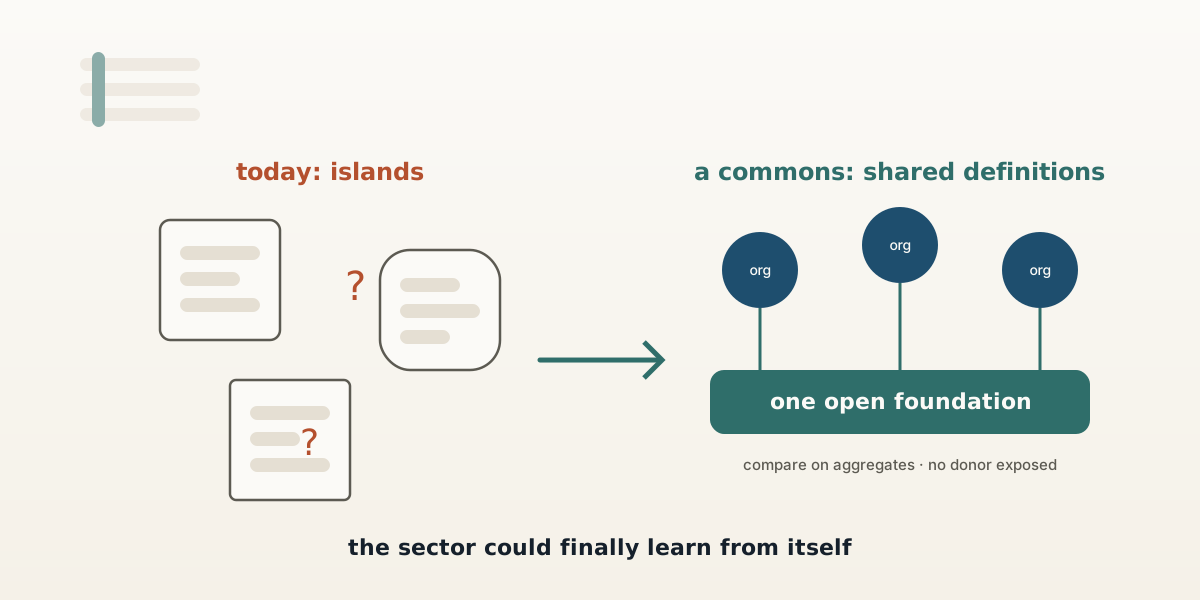
The fundraising sector can’t learn from itself for two reasons that compound: its data is trapped twice over, siloed inside each institution and reshaped differently by every CRM, and the only way to compare has been to expose donor records, which no responsible shop will do. So every team re-invents its definitions alone, and the hard-won lessons of thousands of organizations never add up to shared knowledge. A commons changes both halves of that. This is the whole argument, in one place.
Why can’t nonprofits benchmark against each other?
Three barriers, each real on its own:
- Silos. Your data lives inside your institution; your peer’s lives inside theirs. There’s no shared place, and no one wants one if it means handing over donors.
- Mismatched shapes. Even if you could see each other’s numbers, they wouldn’t line up, because “retention” and “lapsed” mean different things in every shop (why your reports disagree). Comparing them is comparing two different calculations.
- The privacy wall. Traditional benchmarking asks you to upload donors to a third party. A CISO says no, donors never consented, and the law scrutinizes the transfer, so the shops who’d benefit most opt out.
Every advancement shop re-learns the same lessons alone, because the sector has no safe way to pool what it knows. The knowledge exists. It just never adds up.
Trapped twice over
The deepest barrier is structural. Your data isn’t just private (siloed). It’s shaped by whatever CRM you bought, so even with permission it wouldn’t be comparable. One system splits a gift into a commitment and a transaction; another flattens them. One models households as real records; another as a label. Two databases describing the same reality speak different languages, so the sector can’t compare even when it wants to. (That’s exactly the gap a vendor-neutral common data model closes.)
The false choice: insight or privacy
For decades the sector has been handed a false choice: you can have comparison, or you can protect your donors, but not both. Benchmarking meant exposure, so caution meant ignorance. The shops that cared most about donor trust learned the least from their peers, which is exactly backwards.
What a commons changes
A commons dissolves the false choice by separating the two things benchmarking actually needs (a shared question and comparable answers) from the one thing that was never safe to share: the records.
- Shared definitions mean “retention” computed in two shops is the same calculation, so the numbers line up at last.
- Compute-to-data means each organization runs the math inside its own walls and only an aggregate ever leaves, so you compare without exposing a single donor (benchmark without exposing donor data, powered by privacy-preserving analytics).
You don’t have to choose between learning from the sector and protecting your donors. Share the definitions, keep the data. That’s the whole idea.
Why it matters most for the shops with the least
This isn’t an abstract good. The gap between resourced and constrained shops is widening. Analytics and AI raise the bar, big shops clear it, and small shops fall behind serving missions just as worthy. A shared, open foundation is the one thing that closes that gap instead of widening it: it gives a one-person shop the same definitions, the same portability, and the same ability to learn from peers that a large institution can buy. A good foundation shouldn’t need a big budget, and a commons is how it doesn’t.
The through-line
If you’ve followed this blog, you’ve seen the argument arrive in pieces: write your definitions down, separate the promise from the payment, keep your data portable, build the foundation before the AI, compare without exposing. They’re all the same argument. A sector that can trust its own numbers and safely pool what it learns is a sector that gets better together instead of each shop alone.
Where this started, and where it's going
A year and a half ago we said the sector can’t learn from itself and the constrained shops get left behind (why we started). The honest accounting of the road so far is in one year in. The work now is to make the foundation real enough, and neutral enough, that the sector finally can. That’s a commons, and it only works if it’s used.
What you get
A clear picture of why the sector has been stuck, and why it doesn’t have to stay that way: shared definitions plus privacy-preserving comparison turn “we can’t risk it” into “let’s see how we compare.” The sector has always had the knowledge. A commons is how it finally adds up.
Start with the free self-assessment to see where you stand, explore What Becomes Possible, or read why we built this.
Examples use synthetic data. The standard is open and early; treat current releases as drafts.
Related Articles
One year in: what building an open fundraising commons taught us
A year ago we said the sector can't learn from itself and small shops get left behind. Here's what's real, what the first year taught us, and what's still early. Honestly.
A good data foundation shouldn't need a big budget
Can a small shop afford good data infrastructure? Yes. The trustworthy part is mostly discipline, not spend. Definitions, hygiene, and an open standard are free.
Trust your numbers: why we started the Fundraising Commons
Fundraising Commons is an open, vendor-neutral data standard plus free education, so any advancement team can trust its numbers and act on them. Here's why we built it.