
 Fundraising Commons Team 4 min read
 Why your reports disagree depending on who runs them
About the Author
The open, vendor-neutral commons behind the Advancement Common Data Model (ACDM™) and its free educational resources. We write about trustworthy advancement data, portability, and AI-readiness for fundraising teams of any size. Stewards are credited in the colophon, never in the byline.
Your reports disagree because the definitions behind them live in people’s heads and report filters, not in one written place. Two staff run “the same” report, each makes a reasonable assumption about what counts, and they get two different numbers. It’s almost never a data-quality problem. It’s a definition problem, fixable without touching a single record.
Why don’t our fundraising reports match?
Three causes, in rough order of how often they’re the culprit:
- Undocumented definitions. “Active donor,” “lapsed,” “retention,” “major gift” mean whatever each report’s filters happen to say. Nobody wrote the rule down, so everybody invents one.
- Different date fields. Gift date, entry date, and batch date are all “the date” to someone. Pick different ones and your fiscal totals will never reconcile.
- Duplicates and soft credits. A donor on two records is counted twice; a gift credited to both spouses inflates a person-level count. The math is fine; the inputs disagree.
None of these means anyone did anything wrong. They each made a defensible choice. The problem is that defensible isn’t the same as the same.
A worked example
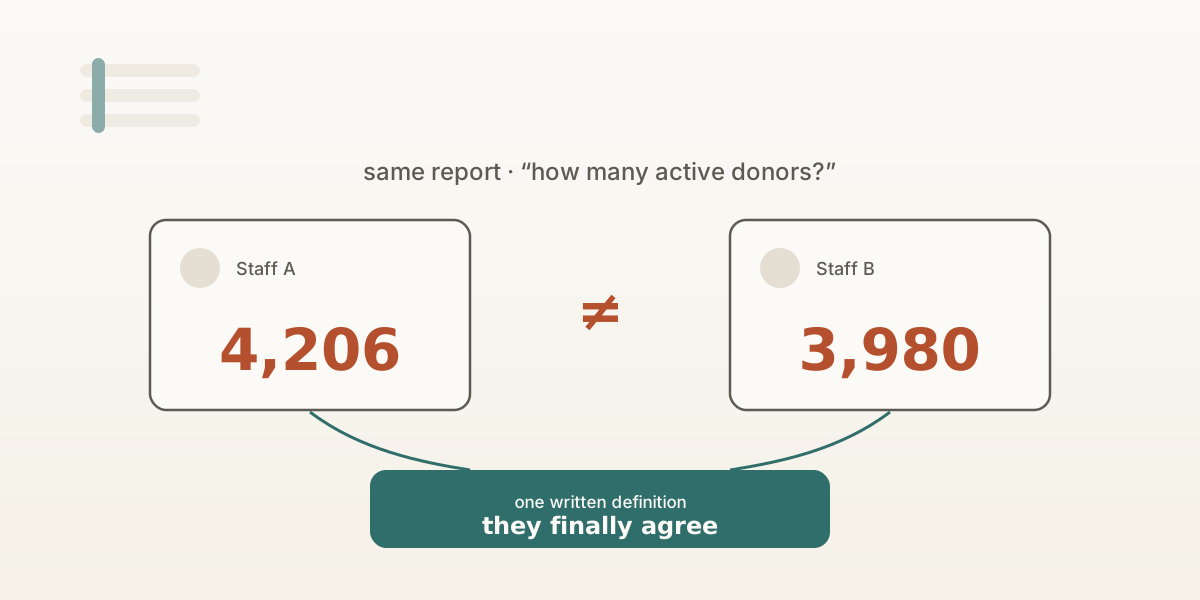
Two staff at Hollow Creek Arts (a synthetic shop; figures are illustrative) are both asked: how many active donors do we have?
| | Staff A | Staff B | |---|---|---| | Window | last 24 months | last 12 months | | Counts pledges-in-progress? | yes | no | | Organizations included? | yes | individuals only | | Result | 4,206 | 3,980 |
Both are right. That’s exactly why it’s corrosive: in a board meeting, whoever happens to have run the report wins the argument. Next quarter, when the other person runs it, the organization appears to have shrunk by 226 donors that never existed or vanished.
Donor counts aren’t the only number that drifts
The same drift quietly infects almost every number you report:
- Fiscal totals swing depending on whether you attribute a gift by its gift date or its entry date. The gap is every gift keyed in January for a December check.
- Retention depends entirely on how you defined “active” in both periods; a drifting denominator makes the rate meaningless.
- Campaign results change based on whether a gift is attributed to the appeal that asked or the fund it landed in.
A wrong definition doesn’t announce itself. It just produces a confident, plausible number that won’t match the next one.
The fix: a definitions layer everyone shares
You don’t fix this with a better BI tool. You fix it by moving the definitions out of people’s heads and report filters and into one written, shared place that every report references.
What 'written down' looks like
For each metric, pin four things in a sentence: the window, what counts (which gift types, pledges in progress or not), who counts (people, organizations, households), and which date governs it. Store it once; make every report cite it. Now “active donor” has one meaning, and the tool is just doing arithmetic on an agreed rule.
This is the heart of the donor-count version of the problem, worked through in detail in “how many donors do we have?” why one question has three answers. The same discipline generalizes to every metric you publish.
A metric is a spec, not a name. Until the spec is written down, every report quietly writes its own, and they will not agree.
What you get when reports agree
Numbers that reconcile across people and quarters. A board that stops getting whiplash and starts trusting the dashboard. Not incidentally, it’s also the precondition for everything harder: you cannot benchmark, forecast, or safely automate on top of numbers that change depending on who pressed “run.” Writing your definitions down is the cheapest, highest-payoff data work most shops never get around to.
It’s also rung one of the ladder we started this whole project to help shops climb. See why we built the Fundraising Commons.
Take the free self-assessment to see where your definitions stand, and see What Becomes Possible once your numbers agree.
Examples use synthetic data. The Advancement Common Data Model is open and early; treat current releases as drafts.
Related Articles
Soft credit vs. hard credit: who actually gave?
Hard credit is the legal donor of record; soft credit recognizes someone else's role in the same gift. One gift, recorded once, can credit more than one person. Here's how.
What "lapsed donor" actually means, and why you must write it down
A lapsed donor gave before but not within an agreed recent window. But "lapsed" is a definition, not a flag. Pin the window, the gift types, and pledges. Here's how.
"How many donors do we have?" Why one question has three answers
Ask three people how many donors you have and you'll get three numbers. Here's why "active donor count" drifts, and the one habit that makes it agree.