
 Fundraising Commons Team 3 min read
 Propensity and capacity scores: what they are, and what they're not
About the Author
The open, vendor-neutral commons behind the Advancement Common Data Model (ACDM™) and its free educational resources. We write about trustworthy advancement data, portability, and AI-readiness for fundraising teams of any size. Stewards are credited in the colophon, never in the byline.
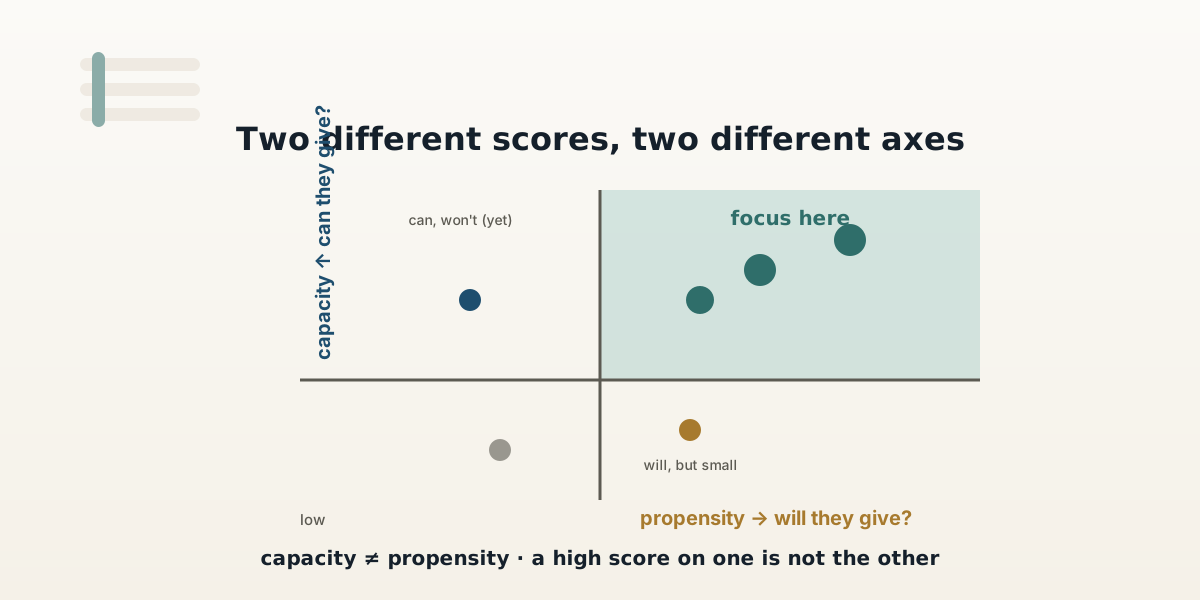
A propensity score estimates how likely someone is to give; a capacity score estimates how much they could give if they did. They answer different questions, sit on different axes, and the most common scoring mistake in fundraising is treating a high score on one as if it were the other. A wealthy donor who never gives and a loyal donor of modest means are opposite errors, and only telling them apart makes either score useful.
What is a propensity score in fundraising?
Propensity is likelihood: based on someone’s history and engagement, how probable is a gift (or a next gift) in a given window? It’s built from behavioral signals: past giving, recency, interactions, and responsiveness. High propensity means “likely to say yes,” regardless of size.
What is a capacity score?
Capacity is ability: how large a gift could this person make if they chose to? It’s estimated from wealth and giving indicators, often via external data, and says nothing about willingness. High capacity means “could give a lot,” even if they never have and maybe never will.
Capacity is “could they?” Propensity is “will they?” Treating a high answer to one as an answer to the other is how prospect lists fill up with people who’ll never give.
Why confusing them is so costly
Lead with capacity alone and you get the classic major-gifts trap: a list of wealthy names with no relationship to you, most of whom will never give, and gift officers burning months on cold, high-net-worth strangers. Lead with propensity alone and you get lots of likely “yes”es for small amounts. That’s efficient, but you’ll miss the donor who could do something transformational. You need both, on two axes.
Read them as a quadrant, not a single rank
The useful move is to plot the two against each other:
| | Low propensity | High propensity | |---|---|---| | High capacity | could, won’t (yet): cultivate the relationship | focus here: able and willing | | Low capacity | low priority | will, but small: steward efficiently |
The top-right is where major-gift effort belongs. The top-left (high capacity, low propensity) is a cultivation problem, not an ask-now problem. Mistaking it for the latter is exactly the misread the single-number approach produces.
What they’re not
Three honest limits worth stating plainly:
- Not certainty. A score is an estimate with error, not a verdict. It orders your attention; it doesn’t predict an individual outcome.
- Not a substitute for judgment. It’s a starting point a gift officer refines with relationship knowledge no model has, which is the same posture as from hunch to score.
- Not trustworthy on bad data. A score computed on duplicated or undefined records is confident noise. Capacity from a stale external match, or propensity from a fractured giving history, ranks the wrong people convincingly.
Scores inherit your data's flaws
Both scores sit at the top of the maturity ladder. They’re only as good as the clean, connected data beneath them. If “this donor’s giving” is wrong because soft credits aren’t resolved or records are duplicated, every score built on it is wrong too, just harder to question. Predictive work is the reward for the foundation, not a shortcut around it.
What you get
Two scores you can actually act on, one for who to ask now and one for how much to aim for, read together as a map rather than a leaderboard. You stop chasing wealthy strangers who’ll never give and stop overlooking the willing donor who could do far more, because you finally measured the two things separately.
For where predictive work sits on the ladder, see What Becomes Possible; to check the foundation underneath, take the self-assessment.
Examples use synthetic data. The standard is open and early; treat current releases as drafts.
Related Articles
Synthetic donor data: how to test cadences and policies safely
Synthetic donor data is artificial records that mirror your real data's patterns but describe no actual person, so you can test cadences, models, and policies without risk.
From hunch to score: prioritizing a gift officer's week with data
How do you prioritize a gift officer's portfolio? Replace gut feel with a transparent score built on clean, connected data, so the week's calls have a defensible order.
Privacy-preserving analytics: what "raw donor data never leaves your walls" really means
Privacy-preserving analytics sends the computation to your data, not your data to the computation. Only aggregates leave; raw donor records stay inside. Here's how it works.