
 Fundraising Commons Team 4 min read
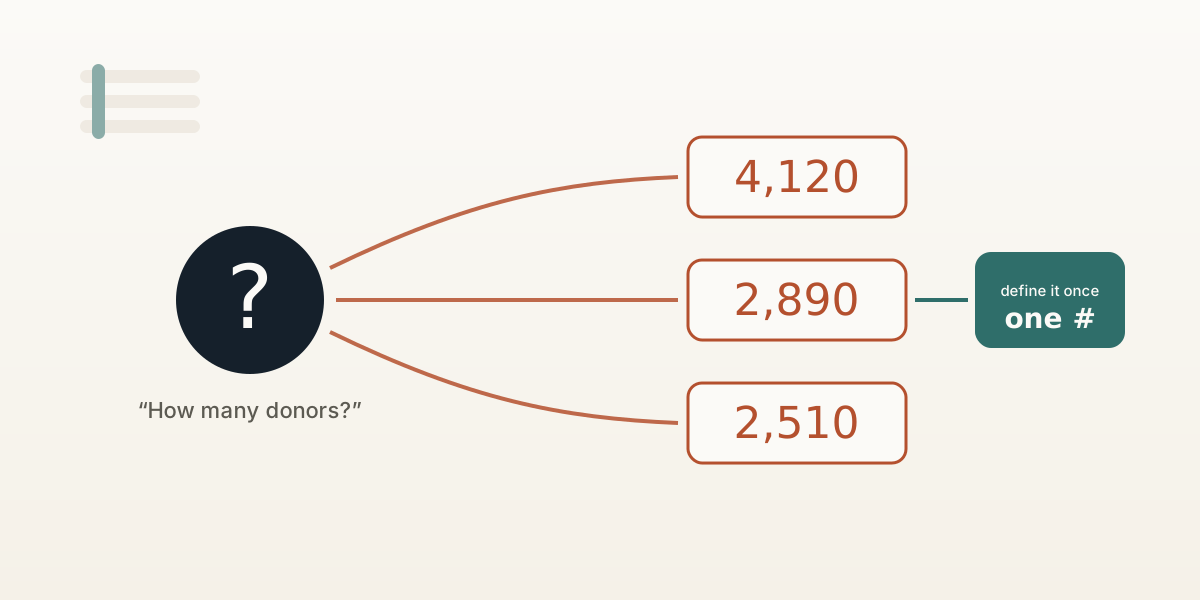
 "How many donors do we have?" Why one question has three answers
About the Author
The open, vendor-neutral commons behind the Advancement Common Data Model (ACDM™) and its free educational resources. We write about trustworthy advancement data, portability, and AI-readiness for fundraising teams of any size. Stewards are credited in the colophon, never in the byline.
Ask three people in your shop how many donors you have and you will get three numbers. That is not a data-quality problem. It is a definition problem. “Donor” and “active” carry four hidden decisions, and until you write them down, every report quietly makes its own. Pin the four, and the number stops moving.
Why does “how many donors do we have” have three answers?
Because “active donor count” is a specification, not a word. Three colleagues can each pull a perfectly correct number and still disagree, because each one silently answered four questions a different way:
- The window. Active since when? This fiscal year, the last 12 months, the last 24?
- What counts as a gift. Do pledges-in-progress count? Soft credits? In-kind gifts? A $0 “gift” used to record an event RSVP?
- Who counts. Individuals only, or organizations and foundations too?
- The unit. Deduplicated constituents, or households? A married couple on two records is either one donor or two, depending on which you pick.
None of these is the “right” answer. The point is that the answer has to be the same one every time, and the only way to guarantee that is to write it down.
A worked example
Take Riverbridge Land Trust (a synthetic shop; the numbers below are illustrative, not real). Their database holds the same giving history all three times. Watch the count move as each decision changes:
| The question they answered | The count they got | |---|---| | Gave anytime in the last 24 months, anyone, by record | 4,120 | | Gave in the last 12 months, individuals only, by record | 2,890 | | Gave in the last 12 months, individuals only, deduped to households | 2,510 |
Same data. Three numbers. Every one defensible, and that is exactly the problem. When the board asks “are we growing our donor base?”, whoever ran the report wins the argument by accident.
A few specific traps inside that table:
- Duplicates inflate the count. One donor split across two records looks like two donors, and looks lapsed on one record while active on the other.
- Pledges fool the window. A donor mid-pledge may not have a new “gift” this year, so a strict reading marks them lapsed even though money is arriving on schedule.
- Soft credits double-count people. If a gift credits both spouses, counting credited constituents can count the household twice.
Write the definition down
The fix is unglamorous and permanent: agree on one definition of active_donor_count, record it where everyone can see it, and make every report reference it. A workable definition pins all four decisions in a sentence:
Active donor = a distinct deduplicated constituent who is an individual and recorded at least one cash gift (excluding pledges-in-progress and soft credits) with a gift date in the last 12 months.
A metric is a spec, not a name. “Active” and “lapsed” are calculations against a written rule, and rules survive staff turnover in a way checkboxes never do.
Two things make this durable rather than just tidy:
- It names a metric, not a flag. “Lapsed” and “active” are calculations against a clear rule, not a checkbox someone ticks.
- It separates the promise from the money. Deciding up front whether a pledge-in-progress counts is what stops the “false lapse,” and that distinction between a commitment and a transaction is one your data model should carry, not your report logic.
The exact numerator, denominator, time basis, and population for counts like this are worth maintaining in one place. The open metric-definitions repository exists for precisely that, so a definition lives once and every team can point to the same one.
What you get when the number agrees
This looks like housekeeping, but it is the floor everything stands on. You cannot benchmark against a peer, forecast a campaign, or let any kind of automation touch your records until “how many donors do we have” has one answer. A retention rate built on a drifting donor count is drifting too. A board that has been given three different growth numbers in three quarters stops trusting all of them.
The payoff
Reports that reconcile, a number you can defend in a board meeting without hedging, and a foundation clean enough to actually build analytics on later. One definition, written down, applied the same way every time.
Not sure where your shop stands? The free five-minute self-assessment locates you on the Clean → Connected → Predictive ladder and points you to the next step. For the bigger picture of what becomes possible once your numbers agree, see What Becomes Possible.
Examples use synthetic data. The Advancement Common Data Model is open and early; treat current releases as drafts.
Related Articles
Gift date vs. entry date vs. batch date: why your fiscal totals never reconcile
Gift date is when the donor gave; entry date when staff keyed it; batch date when it posted. Use them interchangeably and fiscal totals won't reconcile. Here's the fix.
Donor retention rate: the definition most shops get subtly wrong
Donor retention is the share of last period's donors who gave again this period. The subtle error is the denominator: it should be last year's cohort, not this year's.
Soft credit vs. hard credit: who actually gave?
Hard credit is the legal donor of record; soft credit recognizes someone else's role in the same gift. One gift, recorded once, can credit more than one person. Here's how.