
 Fundraising Commons Team 4 min read
 Synthetic donor data: how to test cadences and policies safely
About the Author
The open, vendor-neutral commons behind the Advancement Common Data Model (ACDM™) and its free educational resources. We write about trustworthy advancement data, portability, and AI-readiness for fundraising teams of any size. Stewards are credited in the colophon, never in the byline.
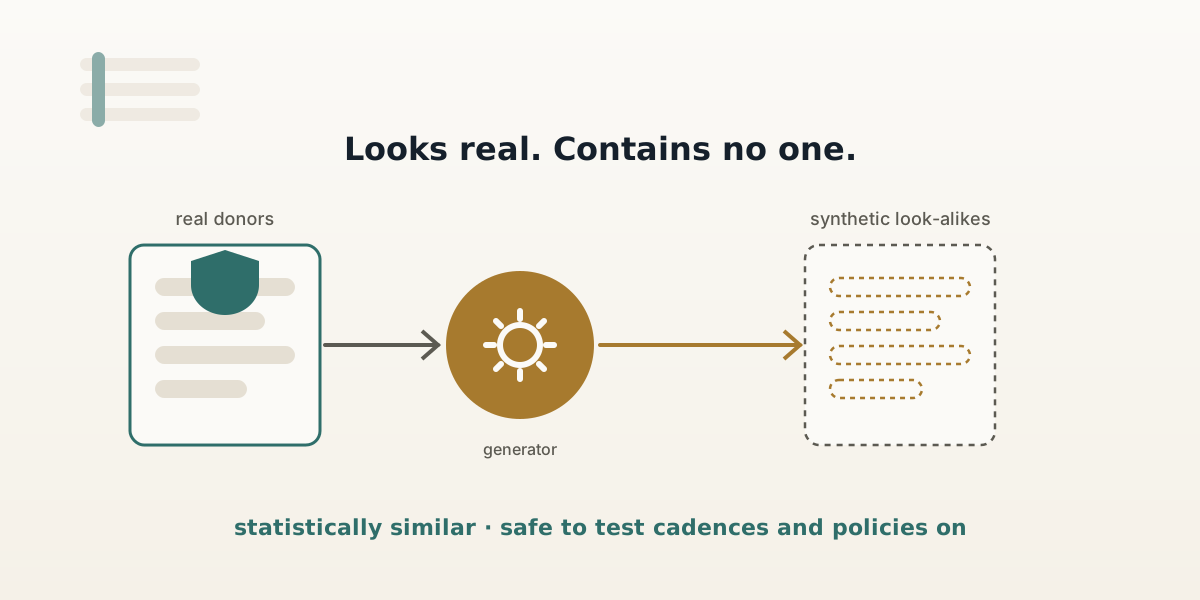
Synthetic donor data is artificial records built to match the statistical patterns of your real data (the spread of gift sizes, the shapes of giving histories, the mix of donor types) while describing no actual person. For testing, it looks and behaves like your file, but there’s no one in it. That’s what lets you try out cadences, models, and policies safely, with nothing real at stake.
What is synthetic data, and why use it in fundraising?
It’s data that’s statistically similar to the real thing but fully fabricated at the record level. You’d use it whenever you want to work with realistic data without exposing real donors:
- Test an outreach cadence before it touches a real donor.
- Develop and demo a model or report without handing developers or vendors live records.
- Try a policy change (“what if we redefine lapsed at 18 months?”) and see the effect on a realistic population first.
- Share a dataset for training or collaboration with zero privacy exposure.
Synthetic data looks real and contains no one. That’s the whole point: realistic enough to learn from, fake enough to be safe.
Why it’s a privacy multiplier
Most of the risk in analytics and AI work comes from real records being in places they don’t need to be: a developer’s laptop, a vendor’s sandbox, a demo environment, a test run of a new campaign. Synthetic data removes the record-level risk from all of those. There’s no donor to expose because there’s no donor in it.
This sits alongside privacy-preserving analytics: that keeps real data in place while letting aggregates out; synthetic data creates a safe stand-in so a lot of work never needs the real data at all. Together they shrink the number of places real donor records have to exist, which, as the GDPR/CCPA picture shows, is exactly where risk concentrates.
A worked example
A synthetic shop wants to test a new sustainer win-back cadence before sending it to 5,000 real donors. They generate a synthetic population that mirrors their real distributions (gift sizes, churn timing, the commitment-vs-transaction structure) and run the whole cadence against it:
They catch a bug that would have sent month-two donors a month-six message, fix it, and then go live. No real donor ever received the broken version, and no real record left the building during testing.
What synthetic data is not
Three honest limits:
Synthetic ≠ magic, and ≠ automatically anonymous
It’s only as good as the patterns it was built from: junk in, junk out. It can’t surface a real individual’s outcome (it’s not them). And generation has to be done carefully: a poorly-built generator can leak information about the real records it learned from, so “synthetic” isn’t a free pass on privacy review. Treat the method as something to get right, not assume.
It also doesn’t replace clean real data for actual decisions. It’s a safe sandbox, not a source of truth. You still need the real foundation; synthetic data just lets you do the risky experimentation somewhere safe first.
Where it fits on the ladder
Synthetic data is a Predictive-rung tool, and like every tool up there, it rests on the foundation below: a generator that mirrors your data is only as meaningful as your data is clean and well-defined. Build the patterns from a messy file and you get realistic-looking nonsense. Foundation first, then the safe sandbox on top.
What you get
A place to experiment with cadences, models, policies, and demos, where mistakes cost nothing and no donor is ever exposed, plus a dataset you can share for collaboration or training without a privacy review every time. Synthetic data turns “we can’t risk testing that on real donors” into “let’s try it this afternoon.”
For where predictive tooling sits, see What Becomes Possible; to check your foundation, take the self-assessment.
Examples use synthetic data (fittingly). The standard is open and early; treat current releases as drafts.
Related Articles
Propensity and capacity scores: what they are, and what they're not
Propensity is how likely someone is to give; capacity is how much they could give. They sit on different axes, and confusing them is the most common scoring mistake. Here's the difference.
Privacy-preserving analytics: what "raw donor data never leaves your walls" really means
Privacy-preserving analytics sends the computation to your data, not your data to the computation. Only aggregates leave; raw donor records stay inside. Here's how it works.
From hunch to score: prioritizing a gift officer's week with data
How do you prioritize a gift officer's portfolio? Replace gut feel with a transparent score built on clean, connected data, so the week's calls have a defensible order.