
 Fundraising Commons Team 4 min read
 A good data foundation shouldn't need a big budget
About the Author
The open, vendor-neutral commons behind the Advancement Common Data Model (ACDM™) and its free educational resources. We write about trustworthy advancement data, portability, and AI-readiness for fundraising teams of any size. Stewards are credited in the colophon, never in the byline.
Can a small shop afford good data infrastructure? Yes, because the part that makes data trustworthy is mostly discipline, not spend. Written definitions, consistent hygiene, and an open, vendor-neutral way to shape your data are all free. The expensive thing, a big platform, is the part you don’t need first, and arguably don’t need to own at all to have numbers you can stand behind.
What “infrastructure” really means here
When people say a small shop “can’t afford good data infrastructure,” they’re usually picturing a six-figure platform. But a foundation isn’t a purchase; it’s a set of properties your data has:
- Records are deduplicated and gifts are dated and attributed consistently.
- “Donor,” “lapsed,” and “retention” mean one written thing, applied the same way every time.
- Your data has a shape that isn’t trapped in one vendor’s model.
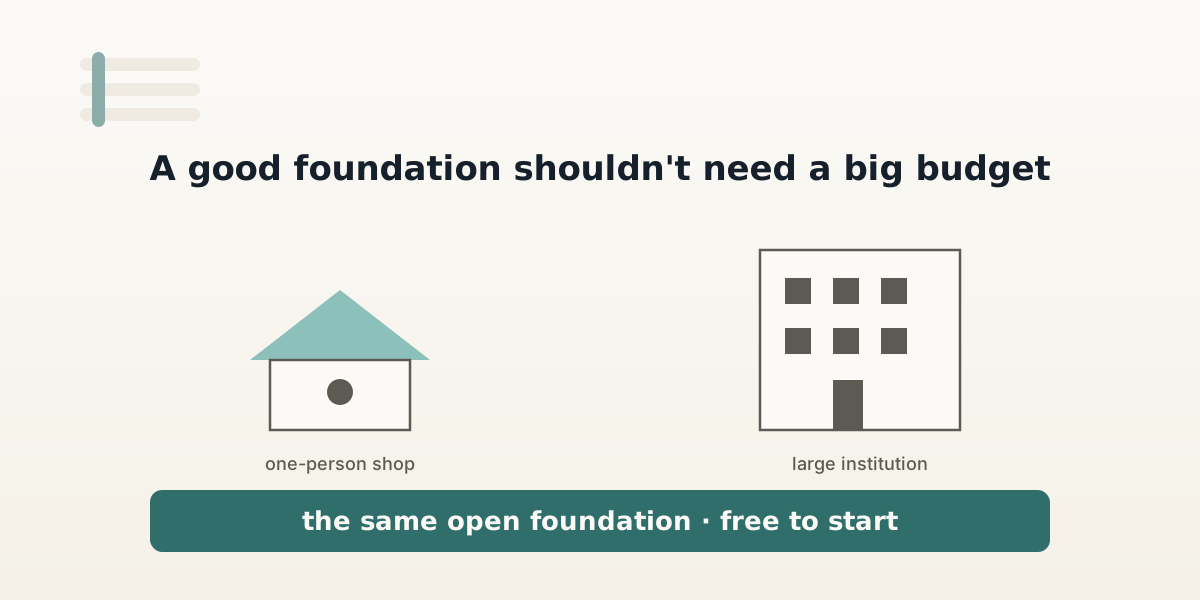
None of those three requires a budget. They require deciding, writing it down, and being consistent, which is exactly why a one-person shop can have a more trustworthy foundation than a far larger institution that never did the work.
A trustworthy foundation is bought with discipline, not dollars. The cheapest shop with written definitions beats the richest shop without them.
What actually costs money, and what doesn’t
It helps to separate the free 80% from the part you can defer:
| Free, and matters most | Costs money (and can wait) | |---|---| | Writing your metric definitions down | A full analytics platform | | Deduplication and consistent gift dating | A data warehouse | | Mapping to an open, neutral data model | Done-for-you implementation | | The self-assessment and this guidance | Bespoke integrations |
The left column is where trust comes from. The right column makes things faster and bigger once the left column exists, and if you skip the left column, the right column just automates a mess.
Addressing the “Free Software is Expensive” Skepticism
Many advancement VPs and CIOs are rightfully skeptical of “free open source” solutions. They know that free software often comes with a hidden invoice: hiring a specialized developer or an expensive consulting agency just to get the system installed, mapped, and maintained.
Fundraising Commons addresses this Total Cost of Ownership (TCO) head-on. You do not need a software engineer to adopt ACDM. We build and maintain pre-built ETL scripts and schema crosswalks for the most common CRM configurations (like Salesforce NPSP and Microsoft Dynamics). These crosswalks act as translator guides that a standard database administrator or advancement services staff member can run using their existing skills. You don’t have to write custom integration code from scratch; you just deploy the pre-packaged mappings.
Why this matters now (the equity stakes)
The bar is rising. Analytics and AI are becoming the price of entry, and they’re only as good as the data beneath them. Left alone, that widens the gap: resourced shops pull ahead, and tight-budget shops serving missions just as worthy fall behind, not because their work matters less but because the foundation looked out of reach.
A shared, open foundation is what closes that gap instead of widening it. It gives a small shop the same spine a large one stands on. That’s not a nice-to-have; it’s the whole reason we started the Fundraising Commons.
The lowest-budget path that actually works
Climb the ladder narrowly, cheapest rung first:
- Trust the number (free). Write down one definition of “donor”; fix the duplicates that distort it. Start with why your reports disagree and how many donors do we have?.
- Connect the shape (free). Map your data to a neutral model so it’s portable and reconcilable (no migration required).
- Add capability when you’re ready (paid, optional). Reporting, a place to analyze, automation: switched on after the foundation holds, and only what you actually need.
Start where it's free
You don’t have to buy anything to begin. Take the self-assessment, it locates you on the ladder and hands you the next free step. Spend money later, deliberately, on speed and scale. Never spend it on trust you could have earned for nothing.
What you get
Numbers you can defend to a board, on a budget that fits a shop your size, and a foundation portable enough that whatever you buy later, you buy from a position of strength rather than desperation. Good data stops being a thing you can’t afford and becomes a thing you decided to do.
See What Becomes Possible for the destination, or just start with the free self-assessment.
The standard and education are free and openly licensed. Examples use synthetic data; the standard is open and early. Treat current releases as drafts.
Related Articles
Why the fundraising sector can't learn from itself, and what a commons would change
Nonprofits can't benchmark against each other because data is trapped twice over and comparing has meant exposing donors. A commons changes both. Here's the whole argument.
One year in: what building an open fundraising commons taught us
A year ago we said the sector can't learn from itself and small shops get left behind. Here's what's real, what the first year taught us, and what's still early. Honestly.
Trust your numbers: why we started the Fundraising Commons
Fundraising Commons is an open, vendor-neutral data standard plus free education, so any advancement team can trust its numbers and act on them. Here's why we built it.