
 Fundraising Commons Team 4 min read
 One year in: what building an open fundraising commons taught us
About the Author
The open, vendor-neutral commons behind the Advancement Common Data Model (ACDM™) and its free educational resources. We write about trustworthy advancement data, portability, and AI-readiness for fundraising teams of any size. Stewards are credited in the colophon, never in the byline.
A year ago we started the Fundraising Commons with a claim: the sector can’t learn from itself, small shops are being left behind, and the answer is an open, vendor-neutral foundation any team can trust. One year in, let’s be honest about what’s actually real, what we got wrong, and what’s still ahead. This is that accounting, not a victory lap.
Is the Fundraising Commons real, and is it maintained?
Yes, and it’s early. What exists today: an open data standard (the Advancement Common Data Model), a growing body of practical writing on the definitions and distinctions that make fundraising data trustworthy, and a free self-assessment. What doesn’t exist yet: a finished spec, a deep bench of named sponsors, or a complete picture of the predictive layer. We’d rather tell you that plainly than oversell it.
What we set out to do
The original case was simple and hasn’t changed: advancement data is trapped twice over (siloed per institution and reshaped by every CRM) so the sector can’t compare or benchmark, every shop re-invents its definitions, and the bar (analytics, now AI) keeps rising. A shared, open foundation closes that gap instead of letting it widen. That’s still the whole point.
What the first year taught us
Four things we believe more strongly now than when we started:
- Definitions are the hardest cheap thing. The single most valuable post we wrote was also the least technical: why your reports disagree. Shops don’t have a data-collection problem so much as an undocumented-definition problem, and writing the definition down is free and unreasonably effective.
- The commitment-vs-transaction line is everywhere. It started as one post (a pledge is not a payment) and turned out to be the hidden cause of false lapses, broken churn math, and double-counted revenue. One distinction, paid forward across half the questions shops ask.
- Portability resonates more than we expected. “Could you leave in 90 days?” reframed lock-in from an abstract worry into a test people could actually run, and that reframe landed.
- AI raised the stakes faster than the foundations were ready for. The year made you can’t run AI agents on rumors with a logo less of a warning and more of a description. The foundation isn’t the prerequisite to the AI story; it is the AI story.
The most useful thing we published all year wasn’t technical. It was: write the definition down. Free, unglamorous, and the floor everything else stands on.
What’s still early, and the honest risks
A commons earns trust by being honest about its gaps, so here are ours:
- The standard is alpha. It will change. Treat current releases as drafts and link to the repository rather than copying its shape.
- Neutrality has to be demonstrated, not asserted. A foundation funded by a sponsor is only credibly neutral when more sponsors and contributors join, and when a competitor adopts it openly. That’s the single biggest thing we have to prove, and we’re early on it.
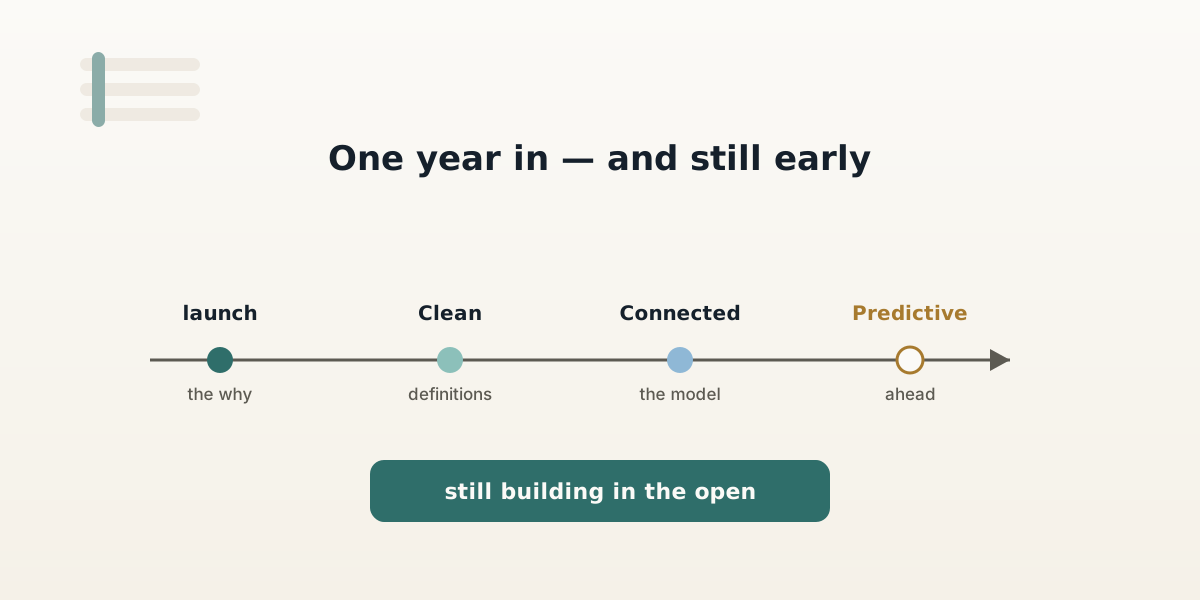
- The predictive layer is mostly ahead of us. We’ve spent the year on the rungs that have to come first (Clean and Connected) because you can’t sell analytics to a shop that doesn’t trust its data.
How to help build it
Use it and tell us where it’s wrong. Contribute to the open standard on GitHub. If your organization wants the sector to have a neutral foundation, help fund or steward it, because neutrality gets stronger with every independent contributor. This is a commons; it improves by being used and challenged in public.
The year ahead
More of the Connected rung (the model maturing in the open), the first real steps into Predictive and privacy-preserving benchmarking, and most importantly the proof obligations: more contributors, visible governance, and the day a competitor conforms. If we earn those, the foundation stops being a promise and becomes infrastructure.
Thank you for reading, using, and arguing with it. That’s exactly how a commons is supposed to work.
New here? Start with why we built this or the story behind it, then take the free self-assessment. See What Becomes Possible for where it’s all headed.
The standard is open and early; treat current releases as drafts. Examples throughout use synthetic data.
Related Articles
Trust your numbers: why we started the Fundraising Commons
Fundraising Commons is an open, vendor-neutral data standard plus free education, so any advancement team can trust its numbers and act on them. Here's why we built it.
Why the fundraising sector can't learn from itself, and what a commons would change
Nonprofits can't benchmark against each other because data is trapped twice over and comparing has meant exposing donors. A commons changes both. Here's the whole argument.
A good data foundation shouldn't need a big budget
Can a small shop afford good data infrastructure? Yes. The trustworthy part is mostly discipline, not spend. Definitions, hygiene, and an open standard are free.