
 Fundraising Commons Team 4 min read
 What "lapsed donor" actually means, and why you must write it down
About the Author
The open, vendor-neutral commons behind the Advancement Common Data Model (ACDM™) and its free educational resources. We write about trustworthy advancement data, portability, and AI-readiness for fundraising teams of any size. Stewards are credited in the colophon, never in the byline.
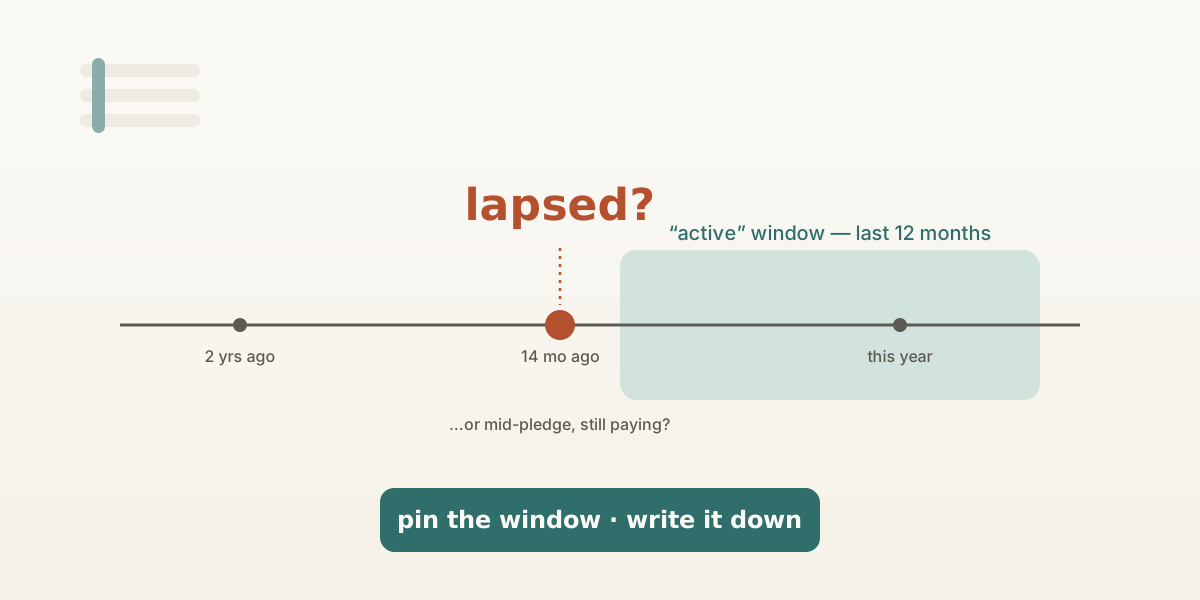
A lapsed donor is someone who gave before but not within an agreed, recent window of time. That sounds simple, until you realize “lapsed” is a metric definition, not a checkbox. Until you pin the window, decide which gifts count, and rule on whether a pledge-in-progress counts as active, your “lapsed” list will quietly include people who never left and miss people who did.
What is a lapsed donor?
The plain-English version: a constituent with giving history whose most recent qualifying gift falls outside a window you’ve chosen (say, no gift in the last 12 months). “Lapsed” is the opposite of “active,” and like active, it only means something once you’ve written down the rule that produces it.
Why “lapsed” is a definition, not a flag
In a lot of CRMs, “lapsed” is a status someone sets, or a saved filter someone built once and forgot. The trouble is that the underlying question (gave, but not recently enough) hides three decisions, and a flag hides which ones were made.
”Lapsed” is a metric definition, not a flag. A status someone ticked can’t tell you which window it assumed, or whether a half-paid pledge counts as alive.
The three decisions to pin
- The window. Lapsed since when? 12 months? 18? Two fiscal years? The right answer depends on your giving cycle, but the number has to be chosen and recorded, not assumed.
- Which gifts count. Does a soft credit keep someone active? An in-kind gift? A $0 record used to log an event? Decide what qualifies as “a gift” for this purpose.
- Does a pledge-in-progress count as active? This is the one that bites hardest. A donor mid-pledge may have made no new commitment this year, yet money is arriving on schedule. Treat them as lapsed and you’ll mail a win-back letter to one of your most reliable supporters.
A worked example
Take a synthetic donor at Riverbridge Land Trust whose last new gift was 14 months ago, but who is two years into a three-year pledge that’s paying on time (figures illustrative):
| Rule you chose | Is this donor “lapsed”? | |---|---| | No gift in 12 months, pledges-in-progress ignored | Yes (gets a reactivation appeal) | | No gift in 12 months, but active pledge = active donor | No (correctly treated as current) | | No gift in 18 months, pledges count | No |
Same donor, same data. Whether they’re “lapsed” depends entirely on a rule that, in most shops, no one ever wrote down.
Write it down
A workable, fully-specified definition reads like a sentence anyone can apply the same way:
Lapsed = a constituent who gave a qualifying cash gift before, but has no qualifying cash gift with a gift date in the last 12 months, and has no pledge-in-progress.
The two failure modes a vague rule produces
False lapses: donors mid-pledge or recently-active-by-soft-credit land on your win-back list and feel forgotten. Missed lapses: a generous window hides people who genuinely drifted, so you never try to win them back. A pinned rule is the only thing that prevents both.
What you get
A reactivation list you can actually trust, with no awkward “we miss you!” emails to donors who never left. A retention rate that means something, because its mirror image is defined. And consistency across staff and quarters, because “lapsed” is a calculation against a written rule, not a judgment call. This is the same discipline behind why your reports disagree and how many donors do we have?. Pin the definition once, and a whole class of arguments simply stops happening.
The exact window, qualifying gift types, and population belong in one shared place. The open metric-definitions repository is built to hold definitions like this so they live once and everyone points to the same one.
See where your shop stands with the free self-assessment, or explore What Becomes Possible once your definitions hold still.
Examples use synthetic data. The standard is open and early; treat current releases as drafts.
Related Articles
Soft credit vs. hard credit: who actually gave?
Hard credit is the legal donor of record; soft credit recognizes someone else's role in the same gift. One gift, recorded once, can credit more than one person. Here's how.
Why your reports disagree depending on who runs them
Two staff run the same report and get two numbers. The cause isn't bad data. It's undocumented definitions. Here's why fundraising reports drift, and the fix.
"How many donors do we have?" Why one question has three answers
Ask three people how many donors you have and you'll get three numbers. Here's why "active donor count" drifts, and the one habit that makes it agree.