
 Fundraising Commons Team 4 min read
 Donor retention rate: the definition most shops get subtly wrong
About the Author
The open, vendor-neutral commons behind the Advancement Common Data Model (ACDM™) and its free educational resources. We write about trustworthy advancement data, portability, and AI-readiness for fundraising teams of any size. Stewards are credited in the colophon, never in the byline.
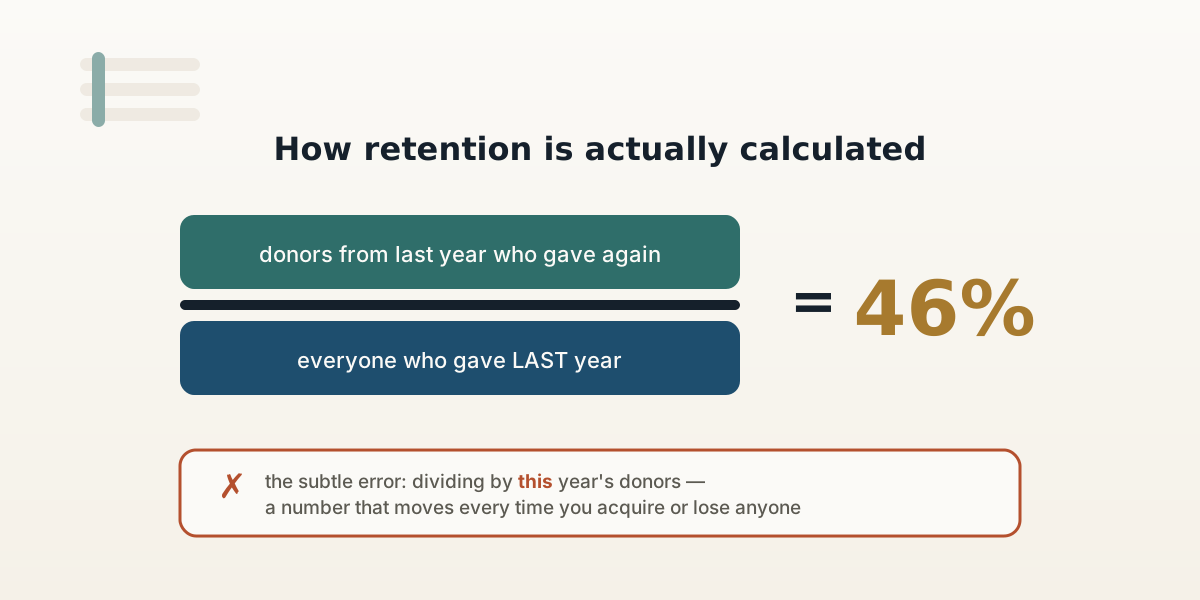
Donor retention rate is the share of last period’s donors who gave again this period. The formula is simple; the error is in the denominator. Retention is “donors retained ÷ everyone who gave last year”: a fixed cohort. Divide instead by this year’s donors (a number that moves every time you acquire or lose anyone) and you get a plausible figure that means nothing and can’t be compared to anyone, including your past self.
How is donor retention rate calculated?
In one sentence: take everyone who gave in the prior period, and find what fraction of that specific group gave again in the current period.
- Numerator: donors from last year who also gave this year.
- Denominator: everyone who gave last year, the cohort, frozen.
If 1,000 people gave last year and 460 of them gave again this year, retention is 46%. The denominator never changes based on what happened this year; it’s a closed group you’re following forward.
The denominator is where it goes wrong
The common mistake is dividing by this year’s donor count. That number is a moving target: it rises when you acquire new donors and falls when others lapse, so “retention” computed against it mashes three separate things (keeping last year’s donors, winning new ones, losing old ones) into one ratio you can’t read.
A clean way to keep it straight: retention is a question about a cohort over time, not a snapshot of this year. Follow the same people forward; don’t re-pick the group based on the outcome.
Retention inherits every definition problem beneath it
Here’s the part that bites shops who think they’ve got the formula right: retention is only as well-defined as the word “donor.” If “active donor” drifts (different windows, pledges-in-progress sometimes counted and sometimes not, organizations in or out) then both the numerator and denominator drift, and the rate wobbles for reasons that have nothing to do with donor behavior.
A retention rate is a fraction built from two donor counts. If “donor” isn’t pinned down, the rate is just two wrong numbers in a trench coat.
So retention can’t be fixed in isolation. It sits on top of the same discipline behind “how many donors do we have?” and why your reports disagree: pin the definition of “donor” first, and retention becomes trustworthy almost for free.
Variants that aren’t wrong, just different
Several retention figures are all legitimate; the error is mixing them or leaving which-one unstated:
| Variant | The cohort it follows | |---|---| | Overall / logo retention | all of last year’s donors | | New-donor retention | only those who gave for the first time last year | | Reactivated retention | donors who had lapsed and came back |
New-donor retention is almost always lower than overall, so comparing your new-donor rate to a peer’s overall rate “proves” a problem that doesn’t exist. Pick one, label it, compute it the same way every time.
The rule, in one line
Retention = (last period’s donors who gave again) ÷ (last period’s donors). Freeze the cohort, define “donor” once, and state which variant you mean. Then the number is comparable across staff, quarters, and eventually peers.
The exact population, time basis, and which gift types count belong in one shared place. The open metric-definitions repository holds definitions like donor_retention so they live once and everyone computes the same thing.
What you get
A retention number you can put in a board deck without an asterisk, one that moves only when donor behavior actually moves. It’s also finally safe to compare to a peer, because you both froze the cohort and defined “donor” the same way. That comparability is what lets you benchmark at all, and it starts with getting the denominator right.
See where your metrics stand with the free self-assessment, or explore What Becomes Possible once your numbers hold still.
Examples use synthetic data. The standard is open and early; treat current releases as drafts.
Related Articles
"How many donors do we have?" Why one question has three answers
Ask three people how many donors you have and you'll get three numbers. Here's why "active donor count" drifts, and the one habit that makes it agree.
The board-meeting number: campaign reporting that survives scrutiny
The single campaign figure you present to the board survives scrutiny only if you decided in advance what counts: pledges, which date, deduped, one source. Here's how.
DAF gifts: who's the legal donor, and why your attribution breaks
For a donor-advised fund gift, the legal donor is the fund sponsor, not the individual who recommended it. Record it backwards and receipts, totals, and stewardship break.