
 Fundraising Commons Team 3 min read
 Future-proofing nonprofit technology: a leader's guide to not betting on the wrong platform
About the Author
The open, vendor-neutral commons behind the Advancement Common Data Model (ACDM™) and its free educational resources. We write about trustworthy advancement data, portability, and AI-readiness for fundraising teams of any size. Stewards are credited in the colophon, never in the byline.
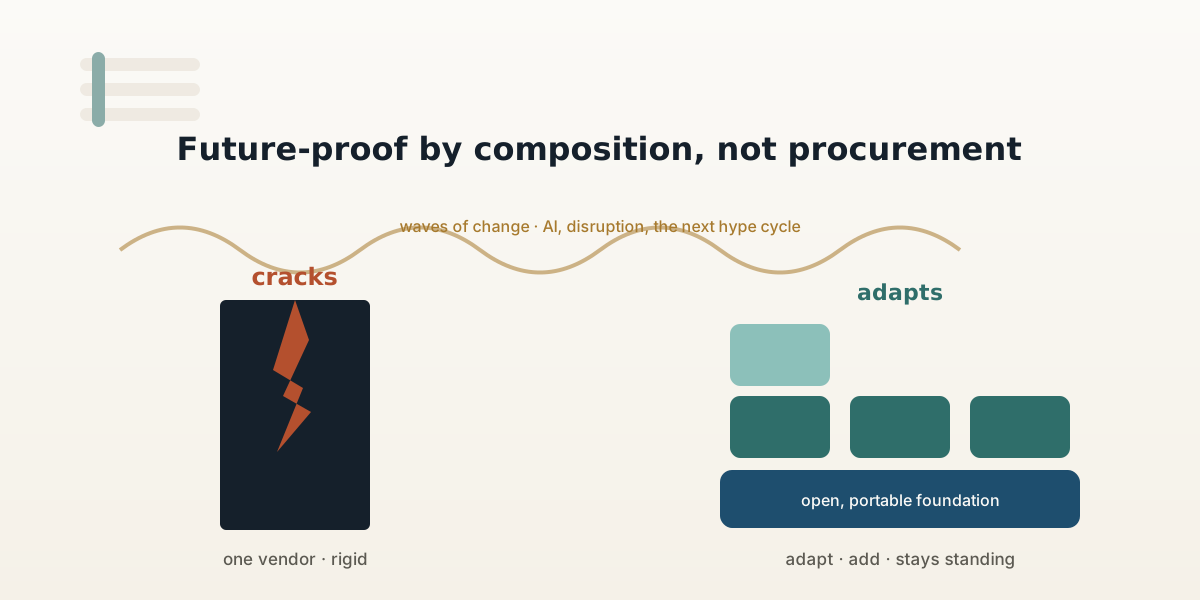
You cannot predict which platform will win the next decade, so the goal of future-proofing isn’t to pick the survivor. It’s to make the question stop mattering. You do that by future-proofing through composition, not procurement: stand on an open, portable foundation and add capabilities you can also remove, so when the next disruption lands, it’s a swap, not a crisis.
How do nonprofits future-proof against AI disruption?
Not by buying the most future-proof-sounding platform. Every vendor claims to be the safe bet; betting the organization on any single one is the opposite of safe. The durable move is to make your foundation (your data and its definitions) independent of any vendor, so that whatever wins, your organization adapts instead of breaks.
Future-proofing isn’t picking the platform that survives the next wave. It’s owning a foundation that doesn’t care which platform wins.
Why “pick the right platform” is the wrong frame
A platform bet is a prediction, and predictions about technology age badly. Two things go wrong when you future-proof by procurement:
- The wave you can’t see. AI is the obvious one now, but it’s just the current wave. The rigid, single-vendor tower looks solid right up until a shift it wasn’t built for hits, and then your data, your definitions, and your roadmap are all trapped inside it.
- Lock-in compounds the risk. The more you build into one monolith, the more expensive it is to move when the bet goes wrong, so you stay, not because it’s best, but because leaving is unthinkable. (That’s the monolith trap.)
Future-proof by composition
The composable posture flips the bet. Instead of choosing the platform that will survive, you make your foundation survive any platform:
- Own your data’s shape. Keep it in an open, vendor-neutral model so it means the same thing everywhere and can move (vendor-neutral common data model).
- Keep your exit tested. Portability you’ve rehearsed is the difference between adapting and being stranded (the portability drill).
- Add capabilities you can also remove. Reporting, analytics, AI: switched on when ready, swapped when better ones arrive, never load-bearing for your data itself.
The AI angle specifically
AI sharpens all of this, because agents raise the cost of being unprepared. An agent is only as good as the data beneath it, and the foundation that makes AI safe (clean, defined, connected, governed) is the same foundation that makes you portable. See you can’t run AI agents on rumors with a logo and the AI-readiness checklist.
So the foundation isn’t the boring prerequisite to the AI story. It is the future-proofing story. Get it right and AI is something you adopt on your terms; get it wrong and AI is one more thing a vendor locks you into.
The question for your next platform decision
Don’t ask “is this the platform that will win?” Ask “if I’m wrong about this in three years, what does leaving cost, and is my data still mine?” A choice that’s cheap to reverse is a choice you can make confidently. A choice that’s expensive to reverse is a bet, however good it looks today.
What you get
The freedom to adopt the best tool of the moment without wagering the organization on it, an exit that stays open as the market churns, and a posture where disruption is an opportunity to swap a component rather than an existential threat to your whole stack. You stop trying to predict the future and start being ready for any of them.
For the full leadership story, see Future-Proofing & AI; for the foundation it rests on, How It Works.
Examples use synthetic data. The standard is open and early; treat current releases as drafts.
Related Articles
Agentic AI for fundraising: a glossary for nonprofit leaders
Agentic AI means software that takes actions, not just answers questions. Here's a plain-language glossary (agent, grounding, guardrails, hallucination) for fundraising leaders.
AI-ready fundraising data: what it actually means (a readiness checklist)
AI-ready data isn't a product you switch on. It's four properties: clean, defined, connected, governed. Here's a practical checklist to see if your data is ready for AI.
You can't run AI agents on rumors with a logo
Are AI agents safe to use on donor data? Only when that data is clean and governed. An agent acting on a duplicate fails at scale. Here's what AI-readiness takes.