
 Fundraising Commons Team 4 min read
 Agentic AI for fundraising: a glossary for nonprofit leaders
About the Author
The open, vendor-neutral commons behind the Advancement Common Data Model (ACDM™) and its free educational resources. We write about trustworthy advancement data, portability, and AI-readiness for fundraising teams of any size. Stewards are credited in the colophon, never in the byline.
Agentic AI means software that takes actions on your behalf, not just answers a question but drafts the email, segments the list, and schedules the ask, with some degree of autonomy. For a fundraising leader, you don’t need to understand the math; you need a handful of terms so you can ask sharp questions and not be sold to. This is that glossary, in plain language, with a fundraising example for each.
What is agentic AI in fundraising?
The shift is from answering to acting. A chatbot answers a question you ask. An agent can carry out a multi-step task (“find lapsed mid-level donors, draft a tailored note for each, and queue them for my review”), making decisions along the way. Useful, and exactly why the data underneath it matters so much more than it did for a passive report.
The glossary
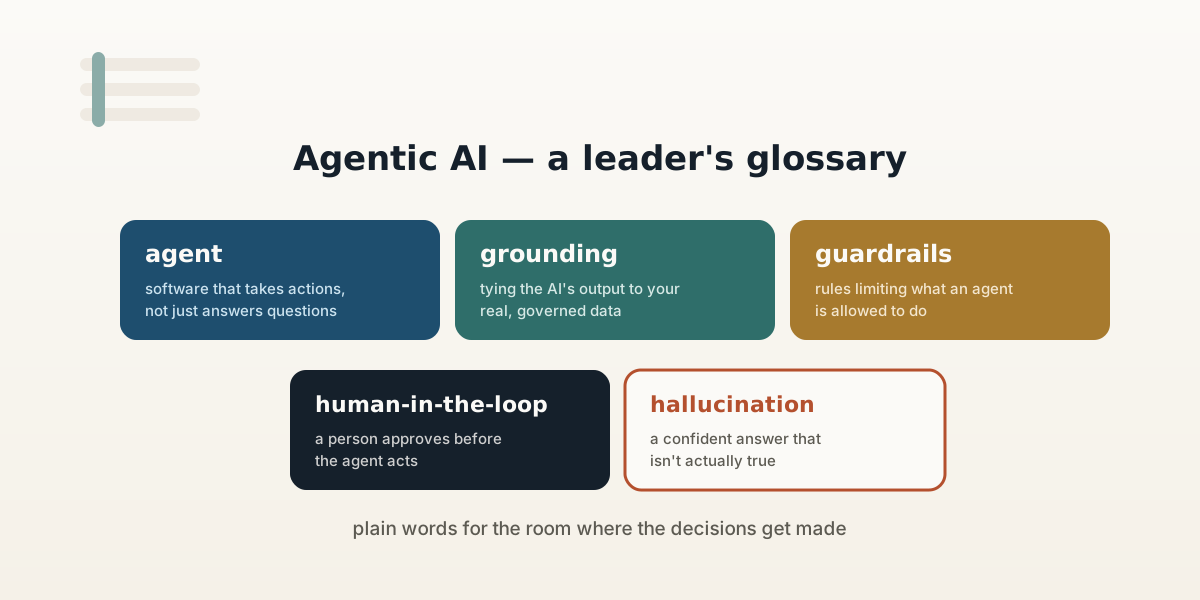
Agent: software that takes actions toward a goal, not just responses. Fundraising example: an agent that builds a gift officer’s call list and drafts the outreach, rather than a tool that just shows you a report.
Agentic / autonomy: how much an agent does without checking with a human. Low autonomy: it drafts, you send. High autonomy: it sends on its own. For donor-facing work, low autonomy is the safer default.
Grounding: tying the AI’s output to your real, governed data instead of letting it improvise. An ungrounded model guesses; a grounded one cites your actual records. This is the whole game for fundraising (see below).
RAG (retrieval-augmented generation): a common way to ground an AI: it retrieves relevant records first, then writes using them. The quality of what it retrieves is capped by the quality of your data.
Guardrails: the rules that limit what an agent is allowed to do (e.g., “never ask for an amount above X,” “never email anyone who opted out”). Guardrails are policy, encoded.
Human-in-the-loop: a person approves before the agent acts. The single most effective safety control for donor-facing automation.
Hallucination: a confident answer that simply isn’t true. The risk isn’t that the AI says “I don’t know”; it’s that it says something wrong in an authoritative voice, and an agent may act on it.
The one idea under all of them
Strip away the vocabulary and every term points back to the same place: an agent is only as good as the data and the rules beneath it. Grounding only helps if the data it’s grounded in is clean and defined. Guardrails only help if your definitions (“lapsed,” “major,” “opted-out”) are written down and correct. Human-in-the-loop only helps if the human can see what the agent based its action on.
Every term in the agentic-AI glossary eventually reduces to one question: is the data underneath this true, and are the rules around it real?
That’s why we keep insisting the foundation is the AI story. See you can’t run AI agents on rumors with a logo for what goes wrong without it, and the AI-readiness checklist for what “ready” actually requires.
Questions to ask a vendor (bring these to the demo)
Five questions that cut through the pitch
- What data does it act on, and where does that data live? (Grounding and portability.)
- What are the guardrails, and can I set them? (Policy you control, not theirs.)
- What’s the default autonomy: does it send, or do I approve? (Human-in-the-loop.)
- What happens when it’s wrong? How would I even know? (Hallucination and auditability.)
- If I leave, does my data (and the work it did) come with me? (No new lock-in; see the portability drill.)
What you get
Enough fluency to evaluate agentic AI on its merits instead of its marketing: to tell grounded from guessing, to insist on guardrails and a human in the loop, and to recognize that the boring data work is what makes any of it safe. The vocabulary is small; what knowing it buys you is not.
For the leadership view on AI and staying future-proof, see Future-Proofing & AI.
This is general, vendor-neutral explanation of common terms; the field is moving fast. Examples use synthetic data; the standard is open and early; treat current releases as drafts.
Related Articles
Future-proofing nonprofit technology: a leader's guide to not betting on the wrong platform
You can't predict the next disruption, so don't try to pick the platform that survives it. Future-proof by composition: an open, portable foundation that adapts. Here's how.
AI-ready fundraising data: what it actually means (a readiness checklist)
AI-ready data isn't a product you switch on. It's four properties: clean, defined, connected, governed. Here's a practical checklist to see if your data is ready for AI.
You can't run AI agents on rumors with a logo
Are AI agents safe to use on donor data? Only when that data is clean and governed. An agent acting on a duplicate fails at scale. Here's what AI-readiness takes.